IPv4 or IPv6: Understanding the differences behind IP address exhaustion
Everything you need to know about IP addresses, the IPv4 address shortage and the transition to IPv6: understanding how they work and the challenges involved.
Quick summary 💡
IPv4 and IPv6 are the two protocols that give every connected device an IP address on the Internet. IPv4, deployed in 1983, is the historical backbone of the Internet — but its address pool has officially been exhausted since 2011. IPv6, launched in 2012, was designed to take over with a virtually unlimited address space. In 2026, both protocols coexist across most infrastructures.
- What are IPv4 and IPv6? Two versions of the Internet Protocol, each assigning a unique address to every connected device. IPv4 dates back to 1983, IPv6 to 2012.
- What is the main difference? The number of available addresses: 4.3 billion with IPv4 (exhausted since 2011), versus 340 sextillion with IPv6. IPv6 is also faster and natively more secure.
- Do both protocols coexist today? Yes. Most infrastructures run dual-stack (both protocols simultaneously). In France, over 80% of traffic already travels over IPv6 in 2026.
- How do I enable IPv6 on my domain name? By adding an AAAA record to your DNS zone file, alongside your existing A record (IPv4).
Every time you access the Internet, whether to visit a website, use a network printer, or simply send an email, devices need to interact and recognise each other. To make this possible, every connected machine has an IP address: a unique numerical address.
Today, two addressing protocols coexist: IPv4, the first protocol to be deployed and still the foundation of the Internet as we know it today; and IPv6, designed to take over from it.
So, IPv4 or IPv6, what is the real difference between these two protocols? And what impact do they have on the management of your infrastructure?
IPv4: the historical protocol… and the exhaustion of its addresses
What is an IP address?
Every device connected to the Internet, whether it is a server, smartphone, or network printer, has an IP address (Internet Protocol): a sequence of numbers that uniquely identifies it on the network. It is thanks to this address that data knows where to go. Without it, no communication is possible.
In the same way, every website has its own IP address. And to avoid having to remember a string of numbers, domain names exist to create a human-friendly alias and translate IP addresses (such as 172.66.43.171) into readable URLs (such as www.netim.com). This is known as DNS resolution.
The birth of IPv4 in 1983
IPv4 (Internet Protocol version 4) was deployed on a large scale in the early 1980s. Its principle is simple: assign each connected device a unique IP address made up of four numbers separated by dots, such as 172.66.43.171.
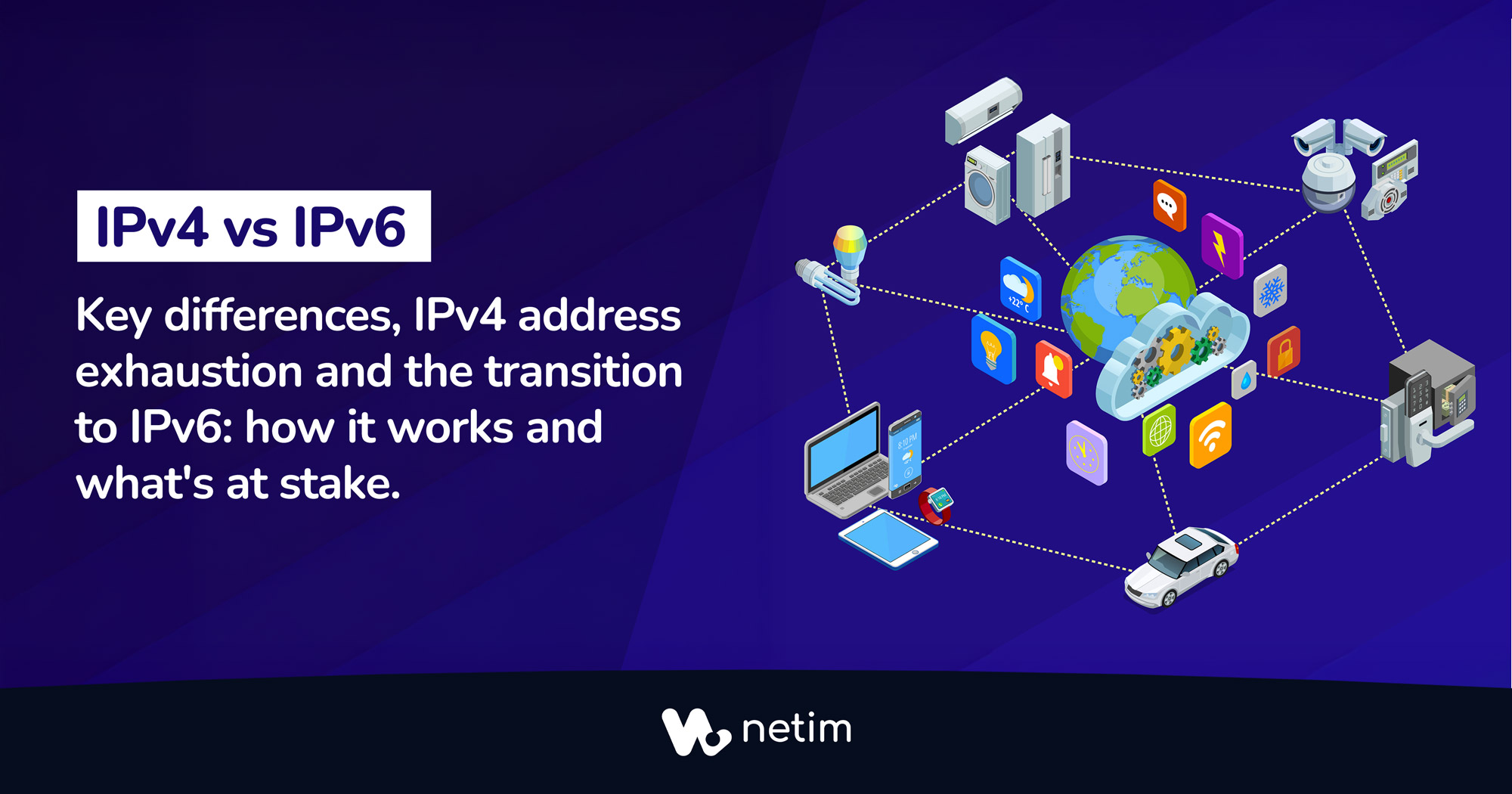
These addresses are encoded in 32 bits, allowing for around 4.3 billion different combinations. In 1983, when the Internet was still in its infancy, this figure seemed almost infinite. But today, it is no longer only computers and printers that need addressing… Between smartphones, tablets, and the explosion of the IoT (Internet of Things), more and more everyday devices are becoming connected and therefore require their own IP address. Smart thermostats, surveillance cameras, smartwatches, sensors, refrigerators…
As early as the beginning of the 1990s, engineers at the IETF (Internet Engineering Task Force) realised that the success of the Internet would lead to IPv4 address exhaustion, and they began building the foundations of a successor capable of supporting the explosion in the number of connected devices: IPv6.
The role of the RIRs and the wake-up call in 2011
IPv4 addresses are managed by five Regional Internet Registries (RIRs), each responsible for a geographical area:
| RIR | Covered region |
|---|---|
| ARIN | North America |
| RIPE NCC | Europe, Middle East, Central Asia |
| APNIC | Asia-Pacific |
| LACNIC | Latin America and the Caribbean |
| AFRINIC | Africa and the Indian Ocean |
These registries receive IP address blocks from the IANA (Internet Assigned Numbers Authority), the global coordinating authority: it manages the worldwide pool and redistributes it to the RIRs. The RIRs then allocate IP addresses to organisations in their region: telecom operators, Internet Service Providers (ISPs), hosting providers, and large companies.
In February 2011, IANA distributed its last five /8 blocks (16,777,216 addresses each) to the five RIRs: global reserves were officially empty. Between 2011 and 2019, the RIRs exhausted the last available IPv4 address stocks, and from 2019 onwards, the era of recycling and speculation began…
Today, if a hosting provider or company wants to obtain IPv4 addresses, it must:
- Join a waiting list with its RIR (hoping that someone releases addresses)
- Buy them on the secondary market (at very high prices)
- Use rental services through specialised platforms
When IP addresses become intangible assets
Scarcity creates value: this is true for domain names, but it is now equally true for IP addresses. Today, IPv4 addresses are traded on a structured secondary market, with specialised brokers (IP brokers) and auctions between companies.
In 2011, an IPv4 address was worth around 10 dollars. In 2026, the price ranges between 30 and 65 dollars per address, depending on the type of block (purchase region, number of addresses, block quality, etc.). For example, a /16 block (65,536 addresses) can be worth between €2 million and €4 million. (Source: I-Lease 2026)
Some major organisations that received huge blocks of 16 million addresses (/8 size) in the 1980s, at a time when nobody was counting them, now hold extremely valuable assets. Stanford, MIT, Apple, Ford: some have returned their stock to their RIR, while others are gradually selling them on the secondary market 💰
The IPv4 address exhaustion: the AFRINIC case
To understand just how much IPv4 scarcity fuels financial interests, we need to look at the fierce legal battle that shook AFRINIC, the African RIR.
As Africa connected its networks later than other continents, AFRINIC still had significant IPv4 reserves at a time when other RIRs were already facing shortages: a highly coveted treasure.
In 2019, AFRINIC discovered that its own CEO had illegally sold blocks of IPv4 addresses to foreign operators for around $30 million. The organisation then realised that millions of addresses allocated to its members were not actually being used on the African continent. The most striking case was that of Cloud Innovation, a company registered in the Seychelles and run by Chinese businessman Lu Heng, which had accumulated 6.2 million IPv4 addresses between 2013 and 2016. These addresses were then resold or leased to clients outside Africa, particularly in China. In 2021, AFRINIC decided to reclaim those addresses. The response was far more aggressive than anyone had expected.
In 2021, Cloud Innovation launched a legal war that gradually paralysed the entire organisation: bank accounts frozen, difficulties paying employees, and eventually AFRINIC being placed under judicial administration in 2023. It was only at the end of 2025 that AFRINIC managed to recover with the election of a new board of directors.
The consequences for the African continent have been severe: five years of paralysis that significantly slowed down the digital transition of a rapidly growing region. The AFRINIC case shows that IPv4 scarcity is not just a technical issue, but also a geopolitical challenge. It creates conflicts of interest that threaten the digital sovereignty of dozens of countries and weakens Internet governance in the regions that need it most.
IPv4 or IPv6: what actually changes
What is IPv6?
IPv6 (Internet Protocol version 6) was finalised in 1998 by the IETF (Internet Engineering Task Force) and officially launched in 2012.
Its main difference from IPv4? Addresses in 128 bits instead of 32 bits for IPv4. This represents around 340 sextillion possible addresses, compared to 4.3 billion for IPv4!
An IPv6 address is made up of 8 groups of hexadecimal characters separated by : and looks like this: 2606:4700:0010:0000:0000:0000:6814:29cd; or in shortened form: 2606:4700:10::6814:29cd
Beyond the huge number of possible addresses, IPv6 also brings major improvements. Without going too deeply into technical details, we can highlight:
- faster processing by routers,
- more stable connections,
- enhanced built-in security,
- but above all, the end of NAT (Network Address Translation): the mechanism that allows several devices to share the same IPv4 address, but which slows down and complicates communication between devices. We discuss NAT in more detail below.
IPv4 or IPv6 : Comparison table
| IPv4 | IPv6 | |
|---|---|---|
| Address format | Decimal Ex: 172.66.43.171 |
Hexadecimal Ex: 2606:4700:10::6814:29cd |
| Address size | 32 bits | 128 bits |
| Number of addresses | 4.3 billion (Exhausted) | 340 sextillion (Virtually infinite) |
| Security (IPsec) | Must be added manually | Native and built-in by default |
| Configuration | Via a central server (DHCP) | Automatic, serverless (SLAAC) |
| Performance | Heavier (often requires NAT) | Faster (direct, “end-to-end”) |
IPv6 transition: understanding the technological in-between in 2026
Although IPv6 is the unavoidable future of the Internet, it has not yet completely replaced IPv4, which remains the historical foundation of global communications. The core issue is that the two protocols are incompatible: they do not speak the same language and therefore cannot communicate with each other. This is why the transition is long and complex: it requires massive investments to modernise global infrastructures.
As early as the mid-1990s, a temporary solution emerged to deal with the shortage of IPv4 addresses: NAT (Network Address Translation). NAT is a mechanism operated by internet routers, or on a larger scale by ISPs (Internet Service Providers), which translates multiple IP addresses into a single public IP address. IPv4 still survives today thanks to NAT: it bought us time, but it is not a sustainable long-term solution.

As a result, the IPv4 to IPv6 transition has been underway for more than twenty years, and the two protocols coexist within most current infrastructures: this is known as dual-stack. This means that a server, router, or device supports both IPv4 and IPv6 simultaneously: connections between devices are automatically established using whichever protocol responds first.
The acceleration of IPv6 adoption
This transitional phase may still last for several more years, but deployment has accelerated significantly in recent years. In May 2026, according to Google’s IPv6 report, nearly 50% of global Internet traffic already runs over IPv6, compared to only 30% in 2020. France is among the world leaders, with an IPv6 adoption rate exceeding 80%.
The figures speak for themselves: more and more governments and major companies are embracing IPv6 (notably AWS in 2025, with the deployment of “IPv6-native” architectures, a strong signal for the entire industry). Refusing this shift today means risking dependence on increasingly expensive and scarce IPv4 addresses, while falling further behind modern infrastructures.
How do I configure my domain name with IPv6?
Enabling IPv6 on your domain name is a quick process that only takes a few minutes: everything is done directly within your DNS zone file. You will find it in the management interface of your domain name, usually provided by your registrar.
Here are the 3 key steps to assign an IPv6 address to your domain name:
- Retrieve the IPv6 address from your hosting provider.
Log in to your web hosting administration panel and copy the IPv6 address dedicated to your server. - Create a DNS AAAA record in your zone file.
Now go to the management interface of your domain name with your registrar, then access the DNS zone file. You will find the A record pointing to the IPv4 address. Create an AAAA record and paste your IPv6 address. - Use a Dual-Stack Configuration.
Keep both records (A and AAAA) active at the same time. Your visitors’ browsers will automatically choose the appropriate protocol.
And tomorrow?
One might think the story ends there… But in April 2026, the IETF published an Internet-Draft describing a potential IPv8 protocol.
The ambition is bold: solve address exhaustion without imposing the dual-stack migration that slowed down IPv6 adoption so much, by treating IPv4 as a subset of a new 64-bit addressing space and rethinking network management as a whole.
Of course, this is only a preliminary proposal, with no official validation or planned adoption at this stage. Nevertheless, it demonstrates one thing: the evolution of Internet protocols is far from reaching its limits…
But before finding out what the future holds, the first step to existing online is still launching your project and securing your brand!
🖊️ Discover all our articles related to domain names.
📧 Don’t forget to subscribe to our newsletter from your Netim Direct account to receive all our news and special offers!