30 years of domain names: the wrong predictions
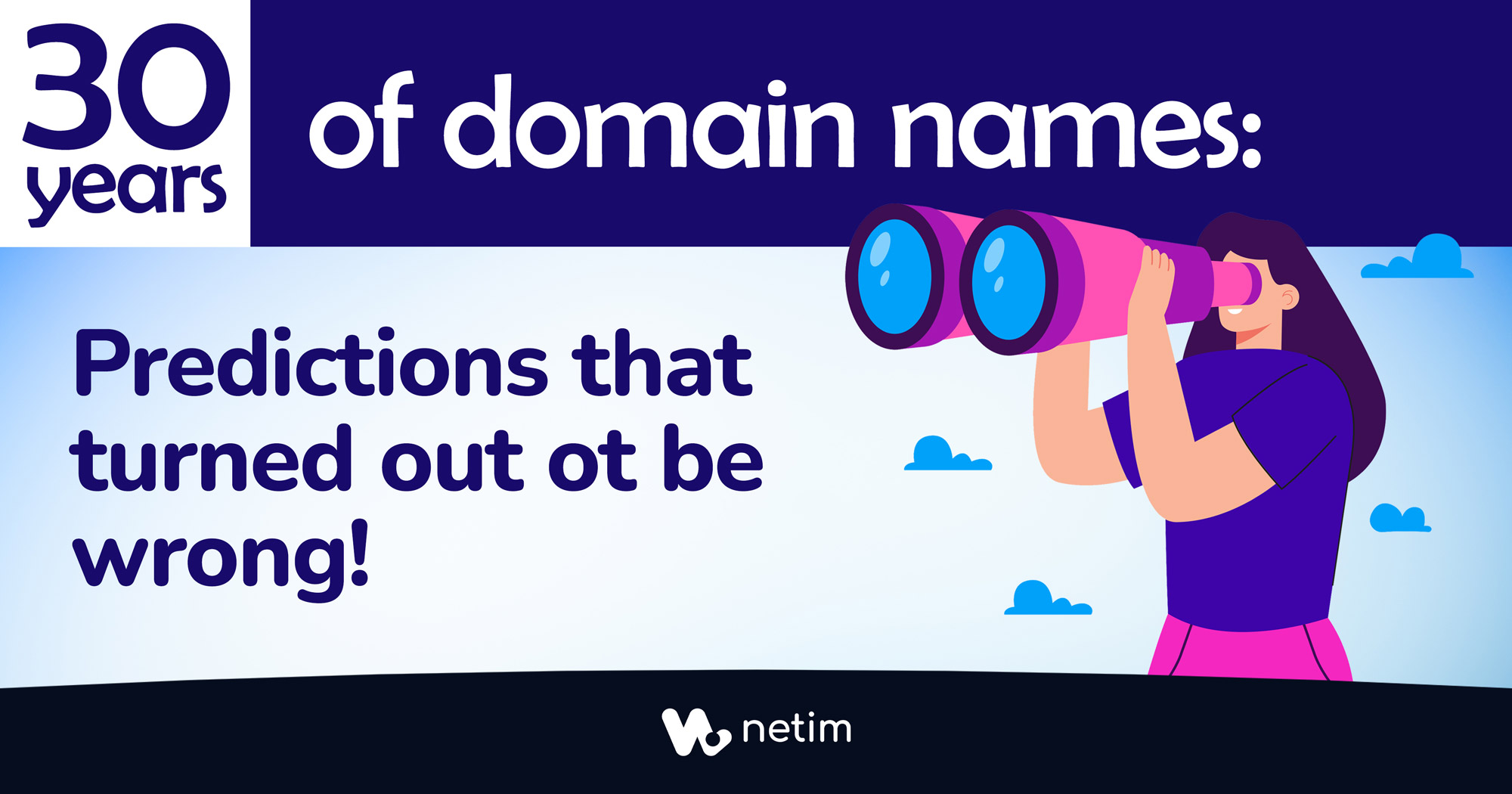
Since the internet became mainstream in the 1990s, experts have regularly predicted the demise of domain names. Web portals, social networks, mobile apps, marketplaces, Web3, NFTs, and then conversational artificial intelligence: each new technology has been presented, in its time, as the future replacement for the DNS (Domain Name System). With 30 years of domain names, they remain at the heart of global digital identity… with a market that keeps on growing.
According to the latest Domain Name Industry Brief published by Verisign, more than 392 million domain names were active worldwide at the end of the first quarter of 2026, an increase of 6.5% year on year. A figure that, on its own, contradicts thirty years of predictions announcing the end of the DNS. Here is a look back at these predictions that never came true, and at the structural reasons behind this resilience.
The graveyard of digital predictions
We have all heard the following predictions: “search engines will replace web addresses”, “mobile apps will kill websites”, “social networks will become the sole gateway for brands”, “NFT domains will replace the DNS”, “AI will make websites obsolete”. Every innovation has transformed the internet, that is a fact. But none has replaced the fundamental infrastructure that makes it possible to identify an organisation on the global network.
A domain name is not just an address: it is a digital asset, an element of trust and a genuine point of control. Understanding why these predictions all failed also helps us better anticipate the next technological waves, generative AI foremost among them.
Prediction no. 1: search engines were going to make domains obsolete
In the 2000s, the thinking was that internet users would systematically go through Google, that there would no longer be any need to remember an address, and that brands would simply need to rank well to exist online.
In reality, users still check URLs before clicking, search engines themselves use domains as an indicator of authority and trust, and marketing campaigns (TV, radio, outdoor advertising) still rely on identifiable names rather than on a Google query. A short, memorable domain name that is consistent with the brand remains an advertising asset in its own right, independent of ranking algorithms. Search optimisation has therefore not replaced the domain: it has increased its value.
Between 2010 and 2020, people imagined that Facebook pages would replace websites, that Instagram would become the sole shop window for businesses and that users would never leave the platforms.
But algorithms change, platforms rise and then decline, and brands remain dependent on third-party players over whom they control neither the rules nor the long-term stability. Some businesses that had bet everything on Facebook lost a large part of their visibility during algorithm changes, with no recourse whatsoever. A domain name, on the other hand, remains an asset that the business owns and controls entirely, whatever the evolution of social platforms.
Prediction no. 3: mobile apps were going to kill websites
Around 2012, the prediction was that everything would go through apps and that browsers would become secondary, or even obsolete for everyday use.
Progressive Web Apps did indeed emerge, but the apps themselves still rely on APIs, servers and… domains! The web remains the universal channel: apps have enriched the ecosystem, without ever replacing the DNS that continues to make them work behind the scenes.
Prediction no. 4: blockchain domains were going to replace the DNS
Between 2021 and 2023, the announcement was that Web3 domains (known as identifiers) would be decentralised, that registrars would become obsolete and that the traditional DNS would gradually disappear. Extensions such as .eth, .crypto or .wallet emerged, driven by strong media enthusiasm.
But their adoption remains limited: no global governance, restricted compatibility with browsers, and a proliferation of competing players and standards that fragment the user experience. The DNS is not just a technology: it is also a form of global governance, universal interoperability and a model that has been proven over several decades.
Fun fact: the leading Web3 companies have all filed applications to create their own extensions within good old Web2… 🥲
Prediction no. 5: artificial intelligence will make websites obsolete
Far more current than the other predictions, the claim we hear today is that internet users will put their questions directly to an artificial intelligence, that websites will be consulted less and that web traffic will disappear. Analyst firm Gartner has, moreover, anticipated a 25% drop in traditional search engine volume by the end of 2026, driven by generative AI and Google’s “AI Overviews”, which already reach more than two billion users every month.
But we can already see that AI relies on content published on the web, on identifiable brands and on reference sites to build its answers. Without content published on domains controlled by organisations, AI would have no reliable sources to draw on. AI may change the way we access information, but it does not remove the need to own your own digital presence. It even makes it more strategic, since being “the” source cited by an AI first requires you to exist, with domain names to back it up.
The domain name market in figures: growth that defies the predictions
The sector’s figures speak for themselves. Far from collapsing, the global domain name market has continued its steady growth for thirty years:
- 392.5 million active domain names worldwide at the end of the first quarter of 2026, up 6.5% year on year (Verisign, Domain Name Industry Brief).
- The long-established .com and .net extensions accounted on their own for 171.9 million domain names at the end of 2026, proof that global standards are resisting fragmentation.
- In France, around 4.3 million .fr domain names are currently active, with a creation rate of about 2,300 new domains per day in 2025 (Afnic).
- Cybersecurity is also driving demand upwards: Interisle’s Cybercrime Supply Chain 2025 report records more than 26 million events linked to phishing, spam and malware, an increase of 60% year on year. This reinforces the need for brands to secure their strategic domains.
This momentum confirms that the domain name is not a relic of the 1990s web, but an infrastructure that is still expanding, driven by the constant creation of new businesses and by the growing range of digital uses.
Why the domain name survives every revolution
Three characteristics explain this resilience:
- Ownership, first of all: you are the registrant and therefore have control over this asset, unlike an account on a third-party platform that can be suspended, downgraded or closed overnight.
- Neutrality, next: the DNS belongs to no social network, no search engine and no AI platform. It provides neutral ground, accessible to everyone under the same rules.
- Interoperability, finally: every browser, operating system, application and service knows how to resolve a domain name, whatever the technology used to reach it: a standard browser, a mobile app or a conversational AI agent.
Conclusion: the DNS is not a fad, it is an infrastructure
For thirty years, technologies have come and gone, uses have evolved and platforms have appeared and then disappeared. Yet behind every digital revolution, one constant remains: the domain name is still the anchor point of digital identity. The recent history of the internet shows that innovations do not replace the DNS; they connect to it.
The role of the registrar has evolved too. From a simple seller of domain names, it has become a partner for the management, security and protection of digital identity, supporting businesses through each of these revolutions.
Key takeaways for businesses
In the face of technological change, a few priorities stand out for securing your digital presence:
- Secure your strategic domains (brand name, variants, common typos, etc.)
Netim offers defensive blocking solutions such as DPML or GlobalBlock to protect a brand across several hundred extensions without having to register them one by one, along with a monitoring service (TMCH) that alerts you as soon as a third party attempts to register a domain name identical to your brand.
- Diversify your extensions
This helps limit the risk of cybersquatting and cover your target markets. With more than 1,300 generic and geographic extensions available, Netim makes it easy to cover several markets from a single client account.
- Implement the DNSSEC protocol
This guarantees the integrity and authenticity of DNS resolutions. At Netim, activating DNSSEC takes just a few clicks directly from the client area, with no particular technical skills required.
- Enable automatic renewal of your domains
Enabling automatic renewal of your domain names and keeping an eye on expiry dates is a good habit to get into. A lost domain cannot always be recovered! Netim offers a free renewal service that can be activated for some or all of your domain names.
- Prepare your visibility in AI engines
Publish reliable, structured content attached to an identifiable domain. Generative AI (ChatGPT, Perplexity, AI Overviews) does not cite brands at random. It relies on sources it considers reliable, namely domains that are established, properly structured (schema markup, FAQs, clear data) and consistent over time.
A stable domain name, combined with a track record of quality content, remains today the main trust signal that these AI systems can verify.
The domain name remains, even today, the most stable foundation on which to build a lasting digital identity.
FAQ
Will domain names disappear with the rise of AI?
No. Generative AI itself relies on content published on identifiable domains to build its answers. Without reference sites attached to domain names, AI would have no reliable sources to cite.
Is it still worth investing in your domain name in 2026?
Yes. All the more so given that the market keeps growing and that visibility in AI answers depends directly on the quality and reliability of the content published on your own domain name.
How can you secure your domain name against new threats?
By enabling two-factor authentication, WHOIS data privacy, the DNSSEC protocol and registrar lock, and by keeping a close eye on renewal dates.