Domain name or registered trademark: which protection for your business?
Registered trademark and domain name are complementary. What are their differences, and how do they protect your online identity?
You have found the ideal name for your brand and your website. But does your trademark automatically protect your domain name? And what happens if someone uses the same name as you? How should you deal with a dispute?
A trademark and a domain name are two different but complementary assets. A trademark is an industrial property right that legally protects a sign for specific goods or services, while a domain name technically identifies your website on the Internet. To protect your online identity over the long term, these two intangible assets should be considered together.
Trademark and domain name: what are the differences?
Trademark and domain name are often confused, yet they have neither the same purpose nor the same legal scope.
A trademark: an industrial property right
A trademark is a distinctive sign (name, logo, slogan, etc.) that identifies the goods or services of a business. Registering your trademark gives you an exclusive right to use it within a defined territory, for specific goods or services, for a renewable period of 10 years.
To do so, you must contact the intellectual property office in the country or territory where you wish to protect your trademark. Some examples of existing offices include:
- 🇫🇷 INPI (National Industrial Property Institute) in France;
- 🇬🇧 UKIPO (UK Intellectual Property Office) in the United Kingdom;
- 🇨🇳 CNIPA (China National Intellectual Property Administration) in China;
- 🇪🇺 EUIPO (European Union Intellectual Property Office) at European level;
- 🌏 WIPO (World Intellectual Property Organization) at international level.
For your trademark application to be accepted, your trademark must meet 4 essential criteria:
- Distinctive: it must not be too generic so that it can be identified and distinguished from competitors
- Non-deceptive: it must not be misleading or include terms that could mislead customers
- Lawful: it must comply with public policy and accepted standards of morality
- Available: the trademark must not already be used for similar goods/services. However, this last criterion is relative: similar trademarks may coexist. It is therefore up to the trademark owner to carry out an availability search before filing the trademark.
The domain name: your address on the Web
The domain name is the address of your website on the Internet (for example, mybrand.fr). It can also be used to create your professional email addresses, such as nom@mybrand.fr. 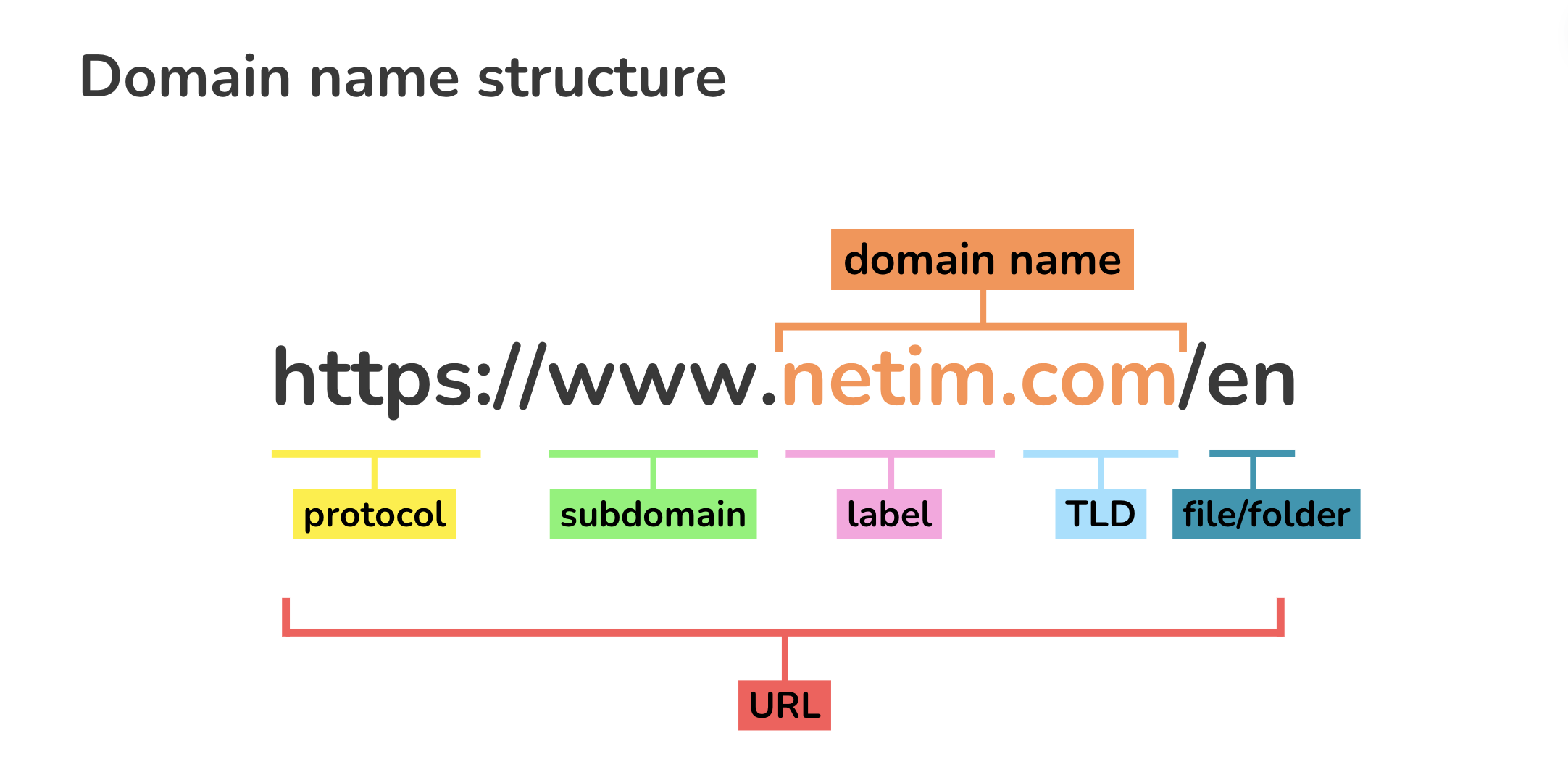
A domain name is registered with a registrar such as Netim, by choosing the name (or label) and an extension (such as .FR, .COM, .NET, etc.).
💡 A domain name gives you the right to use a specific Internet address, according to the rules set by the registry of the relevant extension. Unlike a trademark or a patent, a domain name is not an industrial property right. However, it can constitute a distinctive sign that may benefit from legal protection in certain situations.
Registering mybrand.fr does not protect you against a third party registering mybrand.com or mybrand.paris. It is therefore important to identify the extensions that are strategic for your business and register them in advance to minimise the risk of cybersquatting.
Trademark vs Domain Name
In simple terms, filing a trademark and registering a domain name are two completely independent processes. Registering a domain name does not grant you an industrial property right, and conversely, filing a trademark does not automatically reserve the corresponding domain names.
Here is a summary table of the main differences:
| TRADEMARK | DOMAIN NAME | |
|---|---|---|
| FUNCTION | A trademark identifies goods or services | A domain name is a technical address on the Internet |
| LEGAL NATURE / STATUS | Industrial property right | Distinctive sign used as a web address and registered according to the rules of the relevant extension |
| REGISTRATION | Filed with an intellectual property office | Registered with a registrar |
| COST | In France (INPI): from €190 for 10 years for one class (category of goods or services). Then €40 for each additional class. | A few euros to a few dozen euros per year for a domain name, depending on the TLD and registrar. For example, at Netim, over 10 years: a .COM will cost you €160, or €115 for a .FR. |
| SCOPE | Can be protected at national, European or international level depending on the filing system used and for the goods or services designated | Must be registered separately for each desired extension (.FR, .COM, .DE, .JP…) |
| REQUIREMENTS | A trademark must be distinctive, lawful, non-deceptive and available (it must not infringe certain prior rights) | Assigned according to the “first come, first served” principle, subject to the rules of the registry: eligibility requirements, possible local presence, applicable rules and policies |
| REMEDIES | May be subject to opposition, cancellation proceedings or trademark infringement proceedings, depending on the nature of the dispute | May be subject to out-of-court domain name dispute resolution procedures (UDRP, SYRELI, etc.) or court proceedings, depending on the extension and circumstances |
What strategy should you use to protect your online identity?
Check existing trademarks and domain names
This step is essential: your domain name may infringe a third party’s rights. Indeed, the technical availability of a domain name does not mean that it is legally available.
To avoid future disputes, before filing your trademark and registering your domain name, you should carry out a thorough prior rights search. Check official databases to make sure that no identical or similar trademark already exists for an activity close to yours:
- Official INPI database;
- Official EUIPO database;
- And, more generally, all relevant local databases depending on your market
You should also search for existing domain names using registry search tools, such as the availability search by continent offered by Netim.
Two situations may arise:
- The domain is available: register it quickly if the prior rights searches are conclusive, and do so before registering your trademark (some companies monitor trademark filings in order to automatically register the associated domain names)
- The domain is already taken: visit the website and analyse the holder’s activity before considering an alternative
For example, if mybrand.com is operated by a company offering the same services as you, registering mybrand.fr or mybrands.fr does not automatically protect you against a dispute.
Register the extensions for the countries where you operate
Trademark protection can cover several territories through a single filing. Domain names work differently: each extension must be registered individually.
A good strategy is to register the domain names that are genuinely useful for your business, rather than registering extensions without a clear purpose. For example, if your company operates in France, Germany and Spain, it may be appropriate to secure:
- .FR for the French market;
- .DE for Germany;
- .ES for Spain;
- .EU for European visibility;
- .COM for international visibility.
💡 Note: do not forget to plan for future markets! If you are planning to expand into a new country, check the availability of your domain name with the relevant local extension as soon as possible, as well as its registration requirements.
⚠️ Conversely, file your trademark promptly in the countries where you already operate or plan to develop your business, so that your legal protection matches your commercial presence.
Trademark and domain name: what to do in the event of a dispute?
Despite these precautions, a dispute between a trademark and a domain name may arise. This may happen because a third party registers a domain name using your trademark, or because a trademark using your existing domain name is subsequently filed. The remedies available depend on the nature of the dispute, the priority of the rights, the country concerned and the domain name extension.
A domain name can constitute a prior right…
A domain name is not an industrial property right. However, its use may, in certain circumstances, constitute a prior right that can be enforced against a subsequently filed trademark. The conditions vary depending on the country and applicable law.
In France, since the 2019 trademark law reform, Article L.711-3 of the French Intellectual Property Code recognises, among other things, a domain name whose scope is not merely local as a prior right, where there is a likelihood of confusion with the trademark. In addition, Article L.713-6 provides that a trademark cannot prevent the prior use of a domain name with a local scope, within the territory where that use is recognised.
Example: In the SON LIBRE case (2025), the INPI recognised sonlibre.fr as a prior right after the association demonstrated its actual use and its non-local scope. The “SON LIBRE” trademark application was partially rejected.
…but it can still be difficult to enforce
However, the fact that a domain name is older is not, on its own, enough to prevent a subsequent trademark. Several factors must be taken into account, including:
- actual use of the domain name;
- its geographical scope;
- the goods or services concerned;
- the likelihood of confusion between the signs.
Example: in the AGIRENERGY case (2025), the INPI did not accept the domain name agirenergy.com as a prior right, despite its earlier registration, due to insufficient evidence of its actual use and non-local scope.
Overall, it is important to bear in mind that a trademark is a broader and more significant legal asset than a domain name.
Internationally, there is no single equivalent rule: the possibility of relying on a domain name as a prior right depends on the applicable law in the country concerned and the conditions set out under that law.
In the context of a European Union trademark, the EUIPO may recognise a domain name as a prior right in certain circumstances, but several cumulative conditions must be met. The domain name must, in particular, be subject to actual commercial use, have a scope that is not merely local and, above all, its holder must demonstrate that they have a legally protected right to that name in the country concerned. The mere existence of the domain name is therefore not sufficient: it must be possible to establish a genuine economic activity and an enforceable right in the relevant territory.
Possible remedies in the event of a dispute
Depending on the situation, several options are available:
| Situation | Possible remedy | What you need to know |
|---|---|---|
A third party files a trademark corresponding to your name |
Opposition or cancellation action | If the trademark application is still pending, an opposition may be possible on the basis of a prior right recognised under the applicable law. Once the trademark has been registered, a cancellation action may be considered. These remedies are not automatic: you must in particular demonstrate that the right relied upon is legally enforceable and that the conditions set out in the relevant legislation are met. |
A third party registers a domain name corresponding to your trademark |
UDRP, URS or an extension-specific procedure (SYRELI, etc.) | The remedy depends on the extension concerned. For almost all gTLDs, the UDRP can be used to request the transfer or cancellation of a domain name when the complainant has trademark rights, the domain holder has no rights or legitimate interests, and the domain was registered and used in bad faith. The URS is also available and allows for the rapid suspension of a domain name. For ccTLDs, specific local procedures such as SYRELI or PARL Expert (for .FR) may apply. Please note that if the domain name predates your trademark rights, recovering it may be much more difficult. |
The dispute requires another type of intervention |
Amicable resolution or court proceedings (as a last resort) | An initial contact with the domain holder or a formal notice may sometimes resolve the dispute without proceedings. Some registries also offer mediation services, such as Afnic (.FR) or Nominet (.UK). If this fails, court proceedings may be considered depending on the country and circumstances, including on the grounds of trademark infringement, unfair competition or parasitism. Court proceedings may also allow you to seek financial compensation, unlike the main out-of-court domain name recovery procedures. |
Better safe than sorry
The trademark and the domain name share a common objective: protecting your company’s identity. However, they are governed by different rules and should be considered together from the creation of your business.
Keep four key points in mind:
- Check existing trademarks and registered domain names before creating anything
- Secure your domain names first by registering the strategic extensions that correspond to your current and future markets
- File your trademark in the countries where you will use it (plan ahead for your expansion!)
- Keep evidence of your domain name’s use in case of a dispute
By combining appropriate trademark protection with a consistent domain name registration strategy, you can reduce the risks of confusion, cybersquatting and legal disputes while strengthening your company’s visibility on the web.
How can you protect your domain name?


🖊️ Discover all our articles related to domain names.
📧 Don’t forget to subscribe to our newsletter from your Netim Direct account to receive all our news and special offers!