ccTLD vs gTLD: Understanding the different types of domain name extensions
.COM, .FR, .APP, .IO... Behind every TLD lies a specific category: ccTLD or gTLD. Discover the key differences between these two types of domain name extensions.
A ccTLD (country code Top-Level Domain) is a 2-character extension associated with a country or territory, such as
.FR for France or .DE for Germany. A gTLD (generic Top-Level Domain) is a generic extension, such as .COM, .ORG or .NET, made up of at least 3 characters. Since 2013, a new sub-family of gTLDs has emerged: ngTLDs (new generic Top-Level Domains), thematic extensions such as .SHOP, .APP or .TECH.
When you register a domain name, you face a choice that might seem trivial: .COM, .FR, .NET, .APP, .IO… Hundreds of extensions appear, without really understanding what sets them apart.
These extensions don’t all operate under the same rules. They’re not governed by the same bodies, they don’t all follow the same regulations, and they don’t send the same signals to your visitors or to search engines. Behind every TLD lies an entire precise architecture, established and supervised at a global level.
In this article, we untangle it all: what ccTLDs, gTLDs and even ngTLDs are. What sets them apart, who manages them, how the market is faring in 2026, and why some ccTLDs lead a double life you might not have suspected.
What is a TLD?
Let’s start from the beginning. An extension, or a TLD (Top-Level Domain), is the part of your domain name that comes after the last dot. In netim.com, the TLD is .COM. In netim.fr, it’s .FR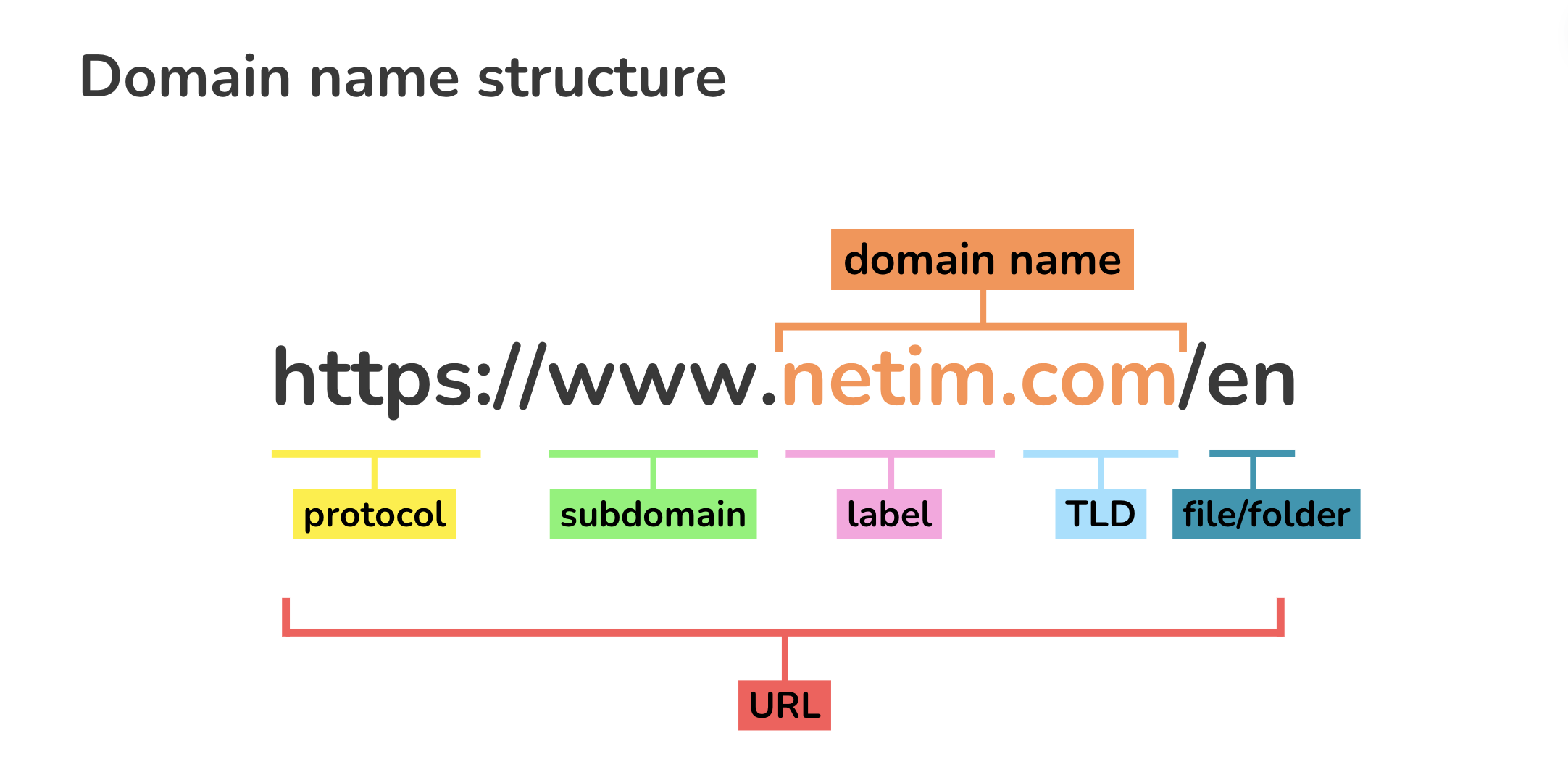
TLDs are a constituent part of the domain name, and are the first link in a broader technical architecture, the DNS (Domain Name System), which translates each domain name into an IP address readable by machines.
Extensions are all listed in the Root Zone Database, the official list maintained by the IANA (Internet Assigned Numbers Authority), the technical branch of the ICANN (Internet Corporation for Assigned Names and Numbers), the international non-profit organisation that governs the domain name system at a global level. 👉 We cover the hierarchy of the domain name industry in more detail at the end of this article.
Today, there are almost 1,600 different extensions, and they are divided into two major families: ccTLDs and gTLDs.
gTLDs: generic extensions
A gTLD (generic Top-Level Domain) is a generic extension: it is made up of at least 3 characters, is not tied to any country, but rather linked to themes. Most gTLDs are open to everyone, with no conditions. Among generic extensions, two sub-families stand out: those created before 2013 and those created after 2013.
Before 2013: the legacy gTLDs
The first gTLDs appeared in the mid-1980s, when the internet was being structured. Originally, their usage was precisely defined:
.COM: commercial websites.ORG: non-profit organisations.NET: networks and infrastructure.EDU: educational institutions.GOV: government bodies
In the 2000s, other legacy TLDs appeared: .BIZ, .INFO, .MUSEUM, .PRO, .TEL…
Over the years, .COM became the default extension for just about everything, to the point where it’s now heavily saturated. Finding a short, memorable name in .COM has become an exercise in patience.
sTLDs (sponsored Top-Level Domains) are extensions managed by sponsors, reserved for specific communities or subjects. Examples:
.GOV (US government entities), .EDU (education), .MIL (US military), .AERO (air transport), .MUSEUM (museums), .COOP (cooperatives), .JOBS (human resources), .TRAVEL (travel industry), .CAT (Catalan community), .POST (postal services), .INT (international organisations and treaties)
After 2013: ngTLDs or nTLDs
In 2012, ICANN launched its New gTLD Program, opening the door to a new generation of extensions. Hundreds of extensions appeared, organised around sectoral or geographical themes. For example:
- Sectoral: .STORE, .SHOP, .APP, .TECH, .DESIGN, .COACH, .PHOTO, .RESTAURANT…
- Geographical: .PARIS, .BZH, .LONDON, .BERLIN, .NYC… These are called geoTLDs 🌎
gTLDs have the advantage of targeting specific sectors, and can be very useful for building a more readable and distinctive online presence. A pizzeria in Paris could register mypizzeria.paris, a hair salon could choose mysalon.hair, etc…
ccTLDs: national extensions
A ccTLD (country code Top-Level Domain) is a 2-character extension associated with a specific country or territory. These codes are defined by the international standard ISO 3166-1, the same reference used for country codes on number plates and passports.
A few examples of ccTLDs:
| Extension | Country or territory |
|---|---|
| .FR | 🇫🇷 France |
| .DE | 🇩🇪 Germany |
| .UK | 🇬🇧 United Kingdom |
| .EU | 🇪🇺 European Union |
| .JP | 🇯🇵 Japan |
| .RE | 🇷🇪 Réunion |
There are currently around 250 ccTLDs in the Latin alphabet, and around 60 ccTLDs in non-Latin scripts (Arabic, Chinese, Cyrillic…).
A ccTLD allows a brand to anchor itself in its local market and immediately build a sense of proximity with its audience. For example, .FR is an excellent choice if your company is French and targets a local market. Moreover, search engines take the ccTLD into account for geographical targeting: a site with a .FR extension will be more prominent in results than a .UK site when a search is made from France.
ccTLDs with eligibility requirements
Unlike gTLDs, whose registries are centralised and managed globally by ICANN, ccTLDs are managed by local entities (associations, private companies or public bodies) that set their own rules on privacy, eligibility and registration.
As a result, many ccTLDs are reserved for residents or legal entities of the relevant country. Before registering, you must be able to demonstrate a local presence (residency, registered office, nationality, trademark…).
| Extension | Registry | Main requirement |
|---|---|---|
| .FR | Afnic (France) | Residency or legal entity in the EEA + Iceland, Liechtenstein, Norway, Switzerland |
| .CA | CIRA (Canada) | Canadian presence required |
| .EU | EURid | Residency or entity within the European Union |
| .JP | JPRS (Japan) | Japanese address or legal entity required |
These requirements are a guarantee of credibility and security of the domain name for internet users.
The “repurposed” ccTLDs: .IO, .AI, .TV and the rest
Some ccTLDs lead a double life… These extensions officially belong to countries or territories, but have been massively adopted for purposes very far removed from their geographical origin:
| Extension | Country/territory of origin | Repurposed use |
|---|---|---|
| .IO | British Indian Ocean Territory | Abbreviation of “Input/Output”, used by tech startups and SaaS tools |
| .AI | Anguilla (small Caribbean island) | Abbreviation of “Artificial Intelligence”, hugely popular in recent years |
| .TV | Tuvalu (Pacific island state) | Ubiquitous in the world of media and streaming |
| .CO | Colombia | Popular alternative to the saturated .COM |
| .ME | Montenegro | Used for personal branding or portfolios |
| .FM | Federated States of Micronesia | Used for radio stations or audio platforms |
These “repurposed” ccTLDs function just like gTLDs in practice. And from an SEO standpoint, this is an important point: Google treats them as generic extensions (see Google’s official list), and not as geographical targeting signals. Registering a .AI will therefore not automatically position you in front of Anguilla’s audience.
ccTLD vs gTLD: a quick comparison
| Criterion | gTLD (generic Top-Level Domain) | ccTLD (country code Top-Level Domain) |
|---|---|---|
| Length | At least 3 characters | 2 characters |
| Governance | Private registries (centralised by ICANN) | Local registries |
| Reach | International | National or territorial perception |
| Eligibility requirements | Usually open to everyone (except for sTLDs and a few exceptions) | Varies by country, often a local address required |
| WHOIS | Strong privacy (standardised by ICANN) | Variable privacy (depending on local legislation) |
| SEO | Geographically neutral | Local targeting signal (except for repurposed ccTLDs) |
| Examples | .COM, .ORG, .NET, .SHOP, .APP… | .FR, .DE, .UK, .JP, EU… |
The extension ecosystem: governance and market
ICANN, registries, registrars: who does what?
Behind every domain name extension lies a chain of players.
- ICANN oversees the entire system at a global level. It validates the creation of new extensions, sets the rules, and delegates their management to registries.
- Registries manage each extension on a day-to-day basis: they maintain the database of registered names and set eligibility requirements. For example: Verisign manages .COM, Afnic manages .FR.
- Registrars (domain name registrars) such as Netim are accredited by ICANN to sell domain names to the public. They act as the interface between you and the registries.
- The registrant — that’s you. You register your domain through a registrar, which then declares it to the relevant registry.
The extension market in 2026
The global domain name market continues to grow. In Q1 2026, the DNIB (Domain Name Industry Brief) counted 392.5 million registered names, 24.1 million more than in Q1 2025 (Source: DNIB Q1 2026).
| Family | Estimated volume (Q1 2026) | Market share | Year-on-year change |
|---|---|---|---|
| Legacy gTLDs | ~194 million | ~49% | Slight decline |
| ccTLDs | ~146 million | ~37% | Stable |
| ngTLDs | ~48 million | ~12% | +31.3% |
Finally, a major development of 2026: ICANN has opened a new application window for new extensions! It opened on 30 April 2026 and closes on 12 August 2026.
In fact, this raises a question: with this next wave of new TLDs, the extensions in the ngTLD category will no longer be so ‘new’. What will we call them in future?
Companies, communities, cities and organisations can apply to obtain their own custom extension: these are called dotBrands. These are brand extensions, such as .LECLERC or .GOOGLE.
The extension landscape will continue to evolve and expand in the years to come… Understanding this whole system is already a solid foundation for choosing the extension that truly fits your project:
You might also like:

🖊️ Discover all our articles related to domain names.
📧 Don’t forget to subscribe to our newsletter from your Netim Direct account to receive all our news and special offers!