SMB/SME: Which domain name to be Visible, Credible, and Protected?
Before launching your website, have you really thought about your domain name? It shapes your visibility on Google, your customers' trust, and the security of your brand. Here is a complete overview to help you make the right choice.
You are an SMB (Small and Medium-sized Business) or an SME (Small and Medium-sized Enterprise) and you are about to launch your website? You have come to the right place. Before diving in and building your site, we would like to invite you to think carefully about your domain name.
Far from being a simple URL, your domain name directly influences your online visibility, your company’s perception, and your brand protection. Yet many businesses make the mistake of rushing into it, without anticipating their future growth or considering the long-term consequences.
This article guides you toward the right choice, combining practical advice, SEO, extensions, and domain name protection solutions, for a website that is visible, credible, and protected.
Being visible: the basics of a good domain name
What is a domain name?
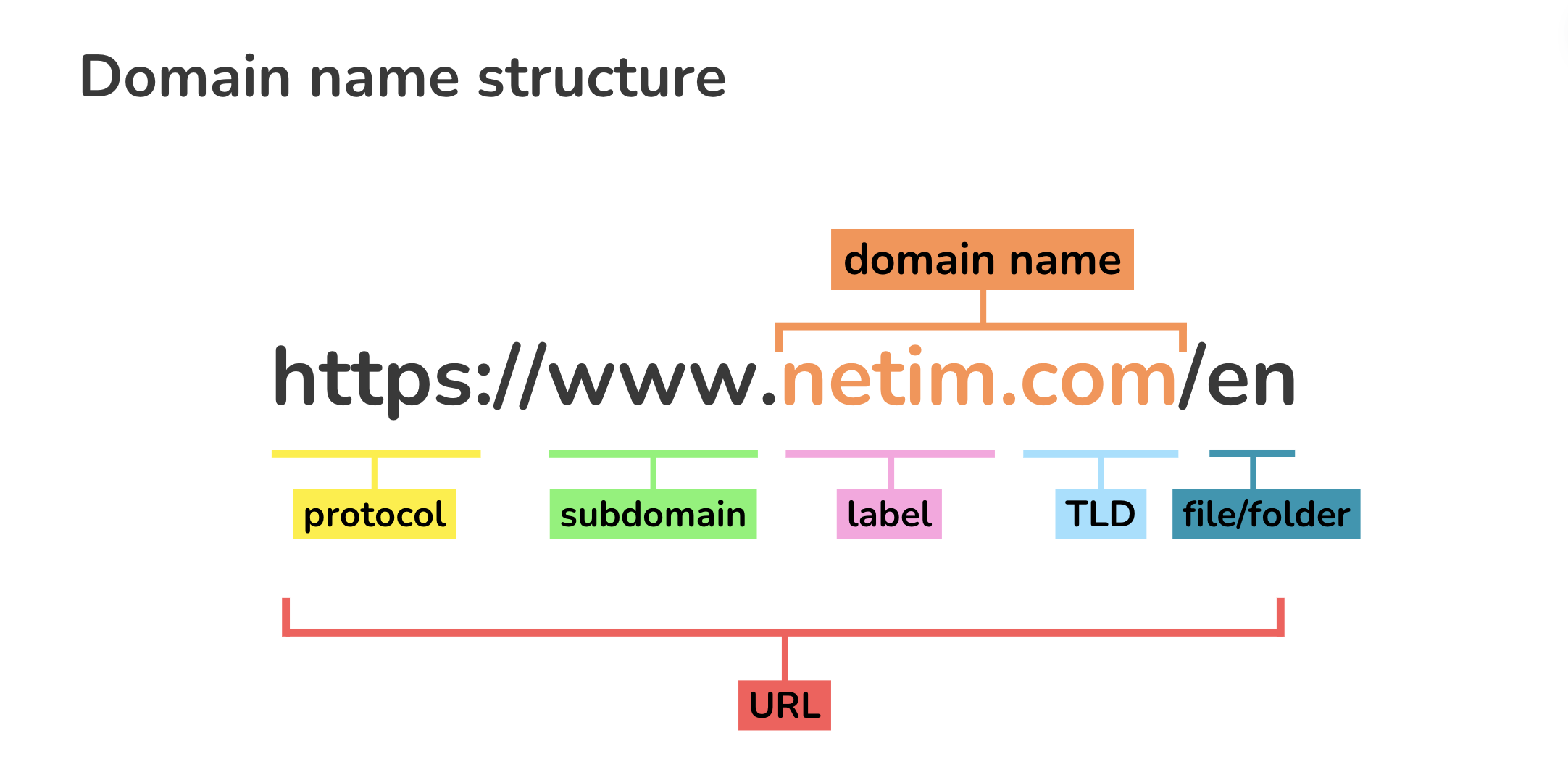
A domain name is the address that gives access to your website: it translates an IP address into a string of characters. For example, netim.com is the domain name that corresponds to the IP address 172.66.43.171: it is DNS resolution. A domain name consists of:
- a name or label (your brand, your activity)
- and an extension (.COM, .SHOP, .NET…)
It is like your company’s digital postal address, but it is also a genuine intangible asset: it carries your image, it is the main entry point for your customers, and the cornerstone of your online visibility.
Domain name and SEO ranking
Search engine optimization, or SEO (Search Engine Optimization), is a set of techniques aimed at improving a website’s ranking in search engine results, such as Google.
SMB or SME, your domain name is one of the first signals sent to search engines. It can indirectly play a key role in your Google ranking.
But a good domain name is not enough: it must be part of a coherent content strategy. Running a professional blog on your site, with regular, well-structured articles that answer your customers’ questions, remains one of the most powerful SEO levers for a small company (SMB or SME).
Being credible: choosing the right extension
The extension is a trust signal for your customers and partners. There are two main categories of domain name extensions:
- ccTLDs (country code Top-Level Domains), tied to a territory: .FR for France, .DE for Germany, .UK for the United Kingdom…
- gTLDs (generic Top-Level Domains), generic: .COM, .NET, .ORG, .APP, .SHOP, .PARIS…
gTLDs: generic or sector-specific extensions
.COM remains the most widely used extension in the world today. It is perfectly suited if you are targeting a global audience, and its reputation speaks for itself. However, it is now heavily saturated, making it increasingly difficult to find an available and easy-to-remember .COM domain name for an SME or an SMB.
Since 2013, many new generic extensions have emerged, covering a wide range of sector-specific (or geographic, with geoTLDs) themes. For instance, if your SMB/SME develops an app, you could choose an explicit and distinctive domain name like example.app, or reinforce your local presence with something like example.london.
The extension can also send a strong signal right from the URL. If you are a freelancer, independant or self-employed professional, personal branding is essential. Your showcase website or portfolio is your online business card: it must immediately communicate who you are and what you do.
ccTLDs: local extensions
ccTLDs, or country specific extensions, are increasingly favored in business strategies worldwide. Beyond improving local SEO as mentioned above, they give the domain name a territorial identity that builds trust and a sense of proximity with users.
Choosing the right ccTLD sends an immediate signal of local commitment: it tells your customers that your business is rooted in their market, subject to local regulations and law, and focused on serving their community. A .DE instantly reassures a German customer, just as a .ES does for a Spanish one, or a .FR for an French audience. For local artisans, retailers, or service providers, this geographic anchor can make all the difference in building customer confidence.
Being protected: preserving your digital identity
Protecting your brand
Registering your domain name in .COM or your national extension and considering the matter closed: that is the classic mistake. With the explosion of new extensions, the risks of cybersquatting have multiplied. A malicious third party could register a variant of your domain name with a different spelling or on another extension, impersonate your brand and use it for phishing campaigns…
At the very least for your SME / SMB, you should register a few variations of your domain name across the most relevant extensions, for example:
mycompany.commycompany.frmy-company.commy-company.fr
Securing your domain name
Protecting your domain does not stop at defensive registrations. One essential aspect, and unfortunately too often overlooked, is securing your customer account with your registrar. Weak passwords, lack of two-factor authentication, uncontrolled access… Poor security can be enough to lose control of your domain in a matter of minutes.
And for good reason: customer accounts at domain registrars are frequently targeted by cybercriminals. Their goal? To take over your domain and misuse it: identity theft, traffic redirection, email interception, phishing campaigns, unauthorized transfer, or even domain deletion. Just imagine for a moment the consequences such an attack could have on your SME / SMB or on your customers!
To minimize the risks, adopt a layered security approach: start by choosing a unique and complex password, then enable two-factor authentication. Set up login alerts to be immediately notified of any suspicious access, and make sure your recovery details (email, phone number) are up to date. 👉 More tips to secure your customer account.
In addition, you can also activate the Registry Lock: an option that freezes any unauthorized operation on your domain, making any attempt to transfer or delete it impossible without manual validation.
Ultimately, choosing your domain name means laying the first stone of your digital identity. For an SMB or SME, it is also a decision that shapes your online visibility, your customers’ trust, and your brand’s security over the long term. When the time comes to launch your site, take the time to think it through and weigh all the stakes, leave nothing to chance!
A question? A doubt? Our team is here to guide you through your domain name registration.
🖊️ Discover all our articles related to domain names.
📧 Don’t forget to subscribe to our newsletter from your Netim Direct account to receive all our news and special offers!