Expired domains: the benefits for SEO | Complete guide
When launching a website, choosing a domain name is sometimes seen as a simple formality. However, it can become a real SEO lever and bring you a significant amount of traffic, which may in turn convert into potential customers. But when it comes to choosing a domain name, a key question often arises: should you opt for a “new” domain name, one available for sale on the secondary market, or an expired domain name?
This strategic decision can have major consequences for organic search performance and may sometimes require a well-managed SEO migration.
Unlike a brand-new domain, an expired domain name may already have an established history, backlinks and domain age, all of which can significantly boost a website’s visibility in search engine results.
But beware: not all expired domains are created equal. Before talking about SEO opportunities, it is essential to fully understand what an expired domain name is and the risks it may involve…
Expired domain name: definition
An expired domain name is a domain that has not been renewed by its holder at the end of its registration period.
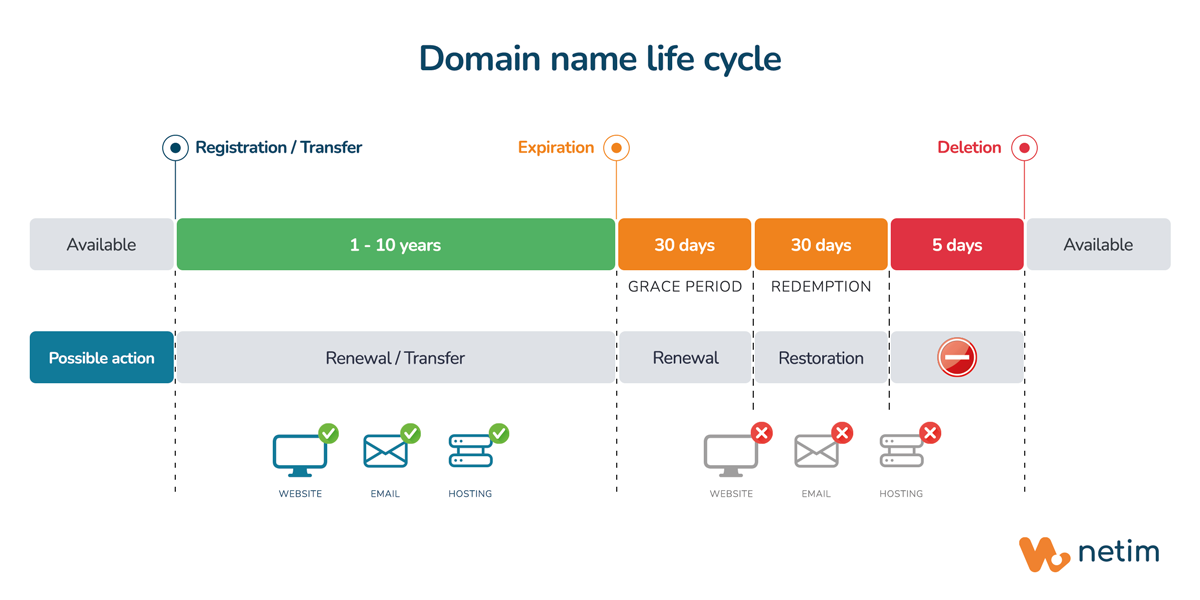
During these phases, the original holder can still recover the domain name, sometimes for an additional fee. Once it has been permanently deleted, the domain name can be registered by a new holder: this is when we usually refer to a re-registered expired domain.
The dangers of letting your domain name expire
A domain name that is not renewed in time can lead to serious consequences, especially if it has already been in use. Here are some of the potential risks associated with failing to renew a domain name:
- Loss of traffic: the website may become inaccessible, resulting in an immediate drop in traffic.
- Disruption of professional emails: email addresses linked to the domain may stop working, leading to lost contacts or even sensitive information.
- Risk of cybersquatting: a third party may re-register the domain to benefit from its reputation, redirect traffic or damage the brand’s image.
- Costly redemption period: once the grace period has passed, recovering the domain becomes more complex… and, above all, more expensive!
These risks explain why an unrenewed domain can be a real threat to its former holder.
How can these risks be avoided?
As you can see, letting a domain name expire carries risks that are best anticipated. To avoid issues linked to domain expiration, several best practices can be implemented:
- Enable automatic renewal with your registrar
- Set up email expiration alerts
- Regularly check the contact information associated with the domain
- Centralise domain name management to avoid oversights
- Anticipate expiration dates as part of a broader digital strategy
These precautions help secure your digital assets and prevent a strategic domain from falling into the wrong hands.
Expired domain names: what are the SEO benefits?
When chosen carefully, an expired domain name can offer a real competitive SEO advantage.
An existing history
Unlike a new domain, an expired domain already has an SEO track record. The main benefits of this history include the domain’s age and the authority it has built with search engines:
- Domain age: although search engines do not officially favour older domains, an established domain often inspires more trust than one that has just been created.
- Domain authority: a domain that has already been indexed, crawled and legitimately used can benefit from a solid credibility base in the eyes of search engines.
An existing backlink profile
When re-registering an expired domain, the new holder may benefit from another major advantage: existing backlinks. This is one of the main SEO benefits of expired domains:
- Existing inbound links: the domain may already have backlinks from quality websites, a key strategy that can sometimes be difficult to implement.
- Time savings: this helps avoid building a netlinking strategy entirely from scratch and accelerates results.
👉 Of course, these links must be relevant, natural, non-toxic and ideally related to the same topic for the expired domain to truly benefit.
Faster positioning in the SERPs
Thanks to its SEO history, an expired domain name can:
- Have new pages indexed more quickly by search engines
- Achieve initial SEO rankings faster than a new domain
- Reduce initial SEO efforts (netlinking, authority, crawl budget)
This represents a significant time saving, especially in competitive industries!
An already established reputation or topic
An expired domain is often associated with a specific topic. This allows you to benefit not only from a semantic history but also from stronger SEO consistency:
- Semantic history: search engines have already identified the domain as legitimate within a given subject area
- SEO consistency: continuing with a similar topic allows you to build on this continuity and avoid sending contradictory signals
💡 This is a real advantage and a major time-saver when building an effective content strategy.
Be careful when choosing an expired domain name
Despite its benefits, an expired domain can become an SEO obstacle if it is poorly selected. As mentioned earlier, certain risks can affect SEO, and it is crucial to be aware of them when re-registering a domain. Between low-quality backlinks, a penalised SEO history or a radical change in topic, here are the key points to consider:
Poor-quality backlinks
A toxic, artificial or penalised backlink profile can seriously harm the future site’s rankings. Today, many free and paid tools exist to analyse the quality of inbound links. Take the time to assess them carefully!
Penalised history
In the past, some domains may have been penalised by search engines. It is therefore essential to avoid this trap: re-registering a domain with a negative SEO history. Removing such penalties can be complex and time-consuming.
It is therefore recommended to analyse the domain’s history before re-registering it:
- Check the Wayback Machine: this tool allows you to view previous versions of a website, assess topical consistency over time, and identify spam pages, sudden language changes, suspicious redirects or automated content.
- In a search engine, type “site:
domainname.ext” into the search bar. This will give you an overview of indexed pages in the SERPs and provide insight into the domain’s past. - SEO tools such as SEMrush, Ahrefs and Majestic can also be used to analyse a domain’s SEO history, although they are often paid solutions.
Overly radical topic changes
A significant gap between the previous and new topic can confuse search engines and cancel out the expected SEO benefits. Ideally, it is best to maintain a similar topic when re-registering a domain to avoid confusion… which could prove detrimental!
Legal considerations: what you need to know…
Re-registering an expired domain with an existing history also involves several legal considerations:
- Do not reuse content from the former website: the content published on the domain must be your own. Reusing previous content could lead to intellectual property rights violations.
- Be mindful of parasitism risks: it is strongly advised not to choose domain names that are identical or too similar to existing brand names.
In summary: is re-registering an expired domain a good idea?
Re-registering an expired domain name can be a powerful SEO lever, provided that potential risks are fully understood. History, backlinks, domain age and brand awareness can all help you save valuable time when ranking in the SERPs, especially compared to a new domain.
However, these benefits only materialise if the domain is thoroughly analysed beforehand. A toxic backlink profile, a penalised history or a drastic change in topic can quickly turn an SEO opportunity into a major obstacle.
An expired domain should therefore never be chosen at random: it must be part of an overall SEO strategy, just like the website’s content. When carefully selected, it can become a powerful and sustainable visibility accelerator.
💡 Looking for an already registered domain name?
👉 With Netim, you can automatically recover the domain names you are interested in as soon as they are deleted. Interested in our backorder system?
Contact our sales team at sales@netim.com for more information!
🖊️ Explore all our domain name articles.
📧 Don’t forget to subscribe to our newsletter from your Netim Direct client area to receive all our news and special offers!