
.COM or ccTLD : Why are national domain extensions becoming increasingly popular?
Why are ccTLDs gaining ground while the .COM is entering a maturity phase, and what needs do they address?
The gTLD (Generic Top-Level Domain) .COM has long been regarded as the go-to extension for websites. Seen as standard and international, and a guarantee of global credibility, it consistently dominate the domain name market, holding a 42% share of the global market (DNIB – Q3 2025).
Yet, in a context of evolving digital habits and increasingly structured online strategies, a clear underlying trend is emerging: businesses are turning more and more towards their national extensions, ccTLDs (Country Code Top-Level Domains), for their online presence.
.FR for France, .DE for Germany or .JP for Japan… 💡 Learn more about ccTLDs and gTLDs.In this article, discover why ccTLDs continue to gain ground, and which needs they address.
The .COM is losing momentum in 2025
Originally intended for “commercial” websites, the .COM extension is now the most widely used extension in the world. Although .COM still holds first place with 161 million registered domain names (42% of the global market), its growth has slowed since 2022:
- Between 2015 and 2021, it showed strong growth: generally +3% to +6% per year, with a global market share of around 47%. (Source: DNIB)
- 2022: weak growth, at +1.1%, and a loss of one percentage point in market share (46%) (Source: Afnic July 2023)
- 2023: a decline of -0.7%, with
.COMlosing domain names for the first time in years and its market share dropping to 44% (Source: Afnic July 2024) - 2024:
.COMexperienced its most challenging year, with a -2% decline (a loss of 3.5 million domain names), and a market share falling to 42% (Source: Afnic June 2025)
This slowdown of .COM in recent years can be explained by several factors:
- A gradual price increase from 2021 to 2024;
- The rise of ngTLDs (New Generic Top-Level Domains) introduced after 2013, which have diluted its market share;
- The maturity of the global domain name market, which is now more stable and saturated;
- And of course, the growth of ccTLDs in local markets, which we will explore in more detail in the second part of this article.
It is important to note that the slowdown of .COM does not indicate a loss of relevance, but rather a natural evolution of a mature and saturated market, leading to a more balanced distribution of market share across different extensions.
The strong comeback of ccTLDs
ccTLDs (country-code Top-Level Domains) are two-character extensions corresponding to a country or territory, such as .FR for France, .CN for China or .DE for Germany. They now represent a significant share of the domain name market (37% of the market) and are increasingly favoured in corporate strategies, particularly in local and European markets.
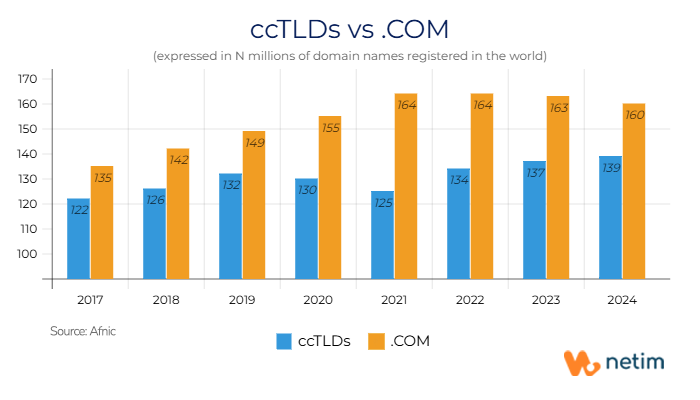
To better understand the progress of ccTLDs over time, here is an overview of their evolution over the past decade:
- From 2017 to 2019: growth from 122 million to 132 million domain names, with a stable market share of 38% (Source: Afnic June 2020);
- From 2020 to 2021: a decline to 125 million domain names, with market share dropping to 36% (Source: Afnic July 2023);
- 2022: a strong rebound with +7.1% growth (134 million domains) and a stable market share of 36% (Source: Afnic July 2023);
- 2023: continued growth of +3% with 137 million domain names and a market share reaching 38% (Source: Afnic July 2024);
- 2024: ccTLDs reached 139 million registered domains (+1.9% vs 2023), with a market share stabilising at 37%. (Source: Afnic June 2025)
With the arrival of ngTLDs in 2013–2014, market shares across extensions were rebalanced. ccTLDs remained stable and even recorded a strong growth in 2022, estimated at +7%. Today, this momentum has slowed but remains positive: +3% in 2023, followed by +1.9% in 2024.
This stability contrasts with the situation of .COM, which, although still dominant, has experienced a clear decline in its overall volume since 2023. In a mature market, ccTLDs continue to be adopted and retained. This resilience confirms that they are an essential digital pillar for businesses worldwide.
🇫🇷 In France, .FR perfectly illustrates this trend, reaching a historic national market share in 2024 of 40.44%, compared with 43.5% for .COM, and showing continuous growth since 2020. This near parity with .COM reflects the growing preference of businesses and internet users for a national extension, seen as a guarantee of credibility, trust and local visibility.
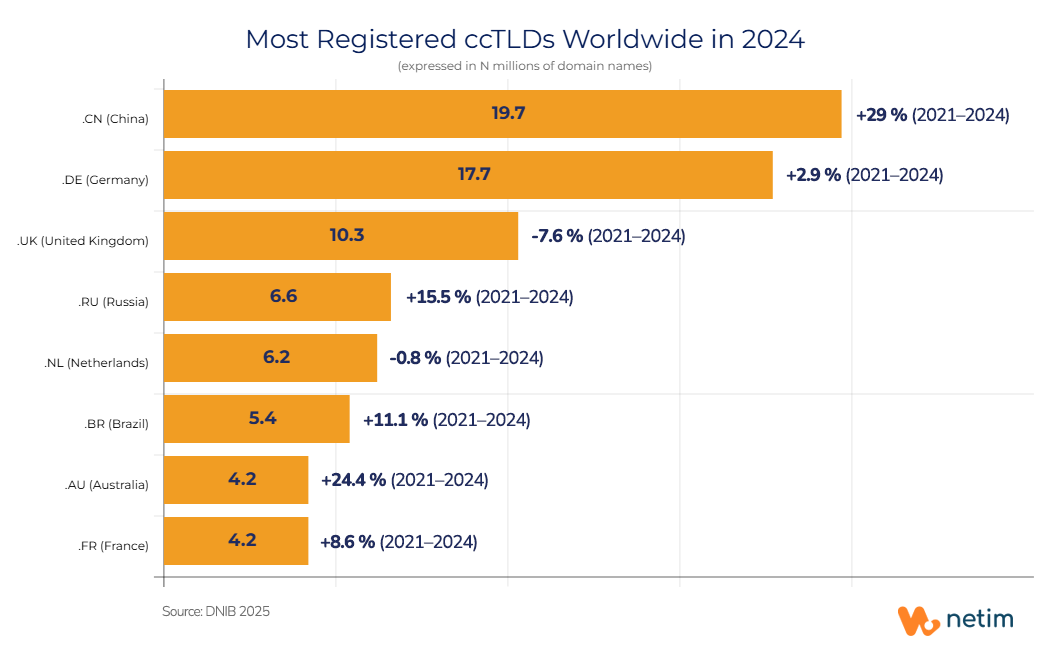
🌎 Indeed, among the top three most widely used extensions worldwide, just behind .COM in first place, are .CN (China) and .DE (Germany). Moreover, while .COM remains the leader in North America, ccTLDs dominate in the other four ICANN regions: Africa (66%), Latin America (71%), Asia Pacific (52%) and Europe (61%). This is also true in many countries, including Germany, the Netherlands, Russia, Chile, Brazil, Poland, Australia and Switzerland… (Source: Dataprovider)
ccTLD vs .COM: which should you choose?
Choosing between .COM and a ccTLD is not just a matter of numbers; above all, it is a question of strategy, target audience and brand perception. Each extension has its strengths and meets different needs.
🌍 Why choose .COM
The reputation of .COM needs no introduction. It is particularly well suited if you are targeting a global audience, beyond your home country, especially if your website is multilingual. Its worldwide popularity is reassuring and it is also the extension that naturally comes to mind when typing a website address.
But beware: as explained earlier, the .COM market is increasingly saturated, making it difficult to find an available domain name, especially for short and/or popular keywords. As a result, internationally oriented businesses are increasingly turning to other gTLDs depending on their industry, such as .APP or .TECH…
💡 Discover our guide to finding the perfect extension for your industry.
🏠 When should you opt for a ccTLD?
ccTLDs (country-code Top-Level Domains), such as .FR, offer several advantages:
- Precise geographic targeting: a ccTLD immediately signals the geographic scope of your business to visitors;
- Trust and reliability: a ccTLD often conveys greater security. For example,
.FRis governed by French law; - Closeness to users: a ccTLD reinforces a sense of authenticity and local credibility for the brand;
- Local SEO optimisation: Google takes ccTLDs into account for geographic targeting. For instance,
.FRwebsites will naturally rank higher in French search results than a.ESsite when a search is performed from France.
In short, ccTLDs combine trust, local targeting, visibility and brand strategy. They are not merely an alternative to .COM, but a key asset for reaching and retaining your local audience and strengthening your territorial presence. If your business targets a national market, the choice is clear: prioritise the relevant country’s ccTLD.
Finally, depending on your strategy, you can also combine the best of both worlds by registering both types of domain names: a .COM for your global brand, and one or more ccTLDs for your local markets.
Indeed, registering both types of extensions is an effective way to reduce the risk of typosquatting on your domain name. If someone else registers it before you, reclaiming it later can be complicated and will cost significantly more than a standard registration, as you would have to go through the secondary market. 👉 Learn more about the value of a domain name on the secondary market.
💡 You might also be interested in these articles:
🖊️ Discover all our articles related to domain names.
📧 Don’t forget to subscribe to our newsletter from your Netim Direct account to receive all our news and special offers!